
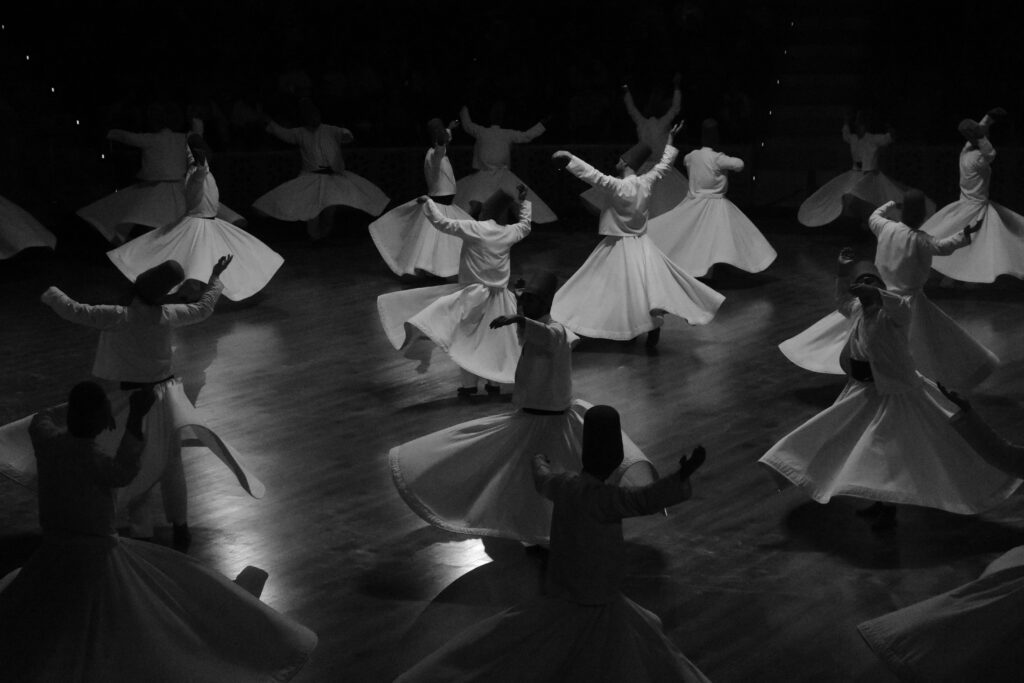
Maybe you’ve heard the word before. In a Rumi quote shared online. In a documentary about whirling dervishes. In a friend’s offhand comment about “Sufi music” at a wedding. But if someone asked you right now to explain what Sufism actually is, you might find yourself stuck.
You’re not alone. Sufism is one of those words that everyone has heard, but almost nobody outside the tradition truly understands. It gets flattened into aesthetics, into spinning dancers and flowery poetry, when in reality it’s something far deeper. A living tradition. A path. A way of relating to God, to yourself, and to the world around you.
This guide is meant to give you the real picture, not the surface version, but the actual heart of it.
The Simple Definition
At its core, Sufism is the mystical dimension of Islam. Where mainstream religious practice often focuses on outward rules and rituals, Sufism turns its attention inward. It seeks a direct, personal experience of God, not just knowledge about God, but a felt closeness to the divine.
Sufism is a mystical Islamic belief and practice that helps Muslims find the truth of divine love and knowledge through a direct personal experience of God.
This doesn’t mean Sufism replaces Islamic practice. It exists within it, deepening it. Think of it less as a separate religion and more as the innermost room of the same house, the space closest to the heart.
Where Sufism Comes From
Sufism didn’t appear overnight. It grew slowly, in the early centuries of Islam, as a response to something many people felt was missing. As the Muslim world expanded and grew wealthier, some believers worried that the faith was becoming too focused on outward success, on power, on material comfort, and not enough on the inner life.
Early ascetics began pulling away from that worldliness. They meditated deeply on scripture, lived simply, and prayed through the night. Over time, this quiet devotion evolved into something richer, a tradition centered not just on discipline, but on love. The idea that a person could love God not out of fear or hope for reward, but simply because love itself was the point.
This shift from strict asceticism to heartfelt love is often traced back to an early woman mystic from Basra, whose teachings reshaped the entire direction of the tradition. From there, Sufism spread and evolved across centuries, producing some of the most beautiful poetry and philosophy the world has ever seen.
The Nafs, the Heart, and the Path Inward
To understand Sufism, it helps to understand a few of its core ideas. One of the most important is the concept of the nafs, the lower self or ego. This is the restless, reactive part of you that seeks comparison, validation, comfort, and control. Left untrained, the nafs runs the show, and life becomes a constant chase after things that never quite satisfy.
Sufism offers a path for softening and transforming the nafs, not by punishing it, but by gently redirecting its energy toward something higher. This is often why people drawn to Sufism find themselves rethinking patterns like constantly comparing their life to others, or feeling like nothing is ever quite enough.
Alongside the nafs sits the heart, the qalb. In Sufi understanding, the heart is capable of real spiritual perception, a kind of inner seeing that goes beyond logic. A heart that’s been clouded by ego, distraction, or unprocessed pain loses some of this capacity. Much of Sufi practice is aimed at clearing that fog so the heart can see and feel clearly again.
If you’ve been carrying old guilt or self-blame that clouds your heart, this is exactly the kind of weight Sufi teaching addresses directly.
Dhikr: The Practice of Remembrance
If Sufism has one signature practice, it’s dhikr, the remembrance of God. This usually involves repeating a sacred word, phrase, or one of God’s names, quietly or aloud, sometimes alone and sometimes in a group.
On the surface, dhikr can look simple, even repetitive. But its purpose runs deep. It’s a way of gently retraining a restless, wandering mind to keep returning to something stable and sacred, rather than getting lost in the endless loop of daily worry and distraction.
This is part of why many people struggling with a mind that won’t settle down find real relief in Sufi-influenced practices. They offer a structured, heartfelt way of quieting inner noise that pure willpower alone rarely achieves.
Poetry as Spiritual Teaching
One of Sufism’s most striking gifts to the world is its poetry. Names like Rumi, Bulleh Shah, Shah Hussain, and Hafiz aren’t just literary figures. They were spiritual teachers who used metaphor, longing, and imagery to describe experiences that plain language could never fully capture.
This is why Sufi poetry so often talks about love, about a beloved, about wine or intoxication, about a moth drawn to a flame. These aren’t literal descriptions. They’re symbols for the soul’s yearning for closeness with God, expressed in a language that speaks to the heart before it reaches the mind.
This is also why Sufi poetry has resonated across centuries and cultures, even with readers who aren’t religious at all. The longing it describes, to be truly known, to belong, to find peace, is deeply human, whether or not you frame it in spiritual terms.
Is Sufism Only for Muslims?
This is one of the most common questions people ask, and the honest answer has some nuance. Sufism is rooted firmly within Islam, and for practicing Sufis, that Islamic foundation matters deeply. It isn’t a separate belief system floating outside the religion.
At the same time, the wisdom found in Sufi teaching, about ego, love, presence, forgiveness, and inner peace, speaks to something universal. Many people from different backgrounds find genuine comfort and insight in Sufi thought, even without practicing Islam formally.
Why Sufism Matters Right Now
In a world that constantly pulls attention outward, toward screens, comparison, and noise, Sufism offers something increasingly rare: a path back inward. It doesn’t promise a life free of struggle. Sufi teachers were often deeply honest about pain, loss, and difficulty. What it offers instead is a way of holding that struggle with more depth, more meaning, and more connection to something larger than yourself.
You don’t need to become a scholar or join a formal order to benefit from Sufi wisdom. Sometimes it starts simply, with a single line of poetry that stops you in your tracks, or a quiet practice of returning your attention to what actually matters, again and again, with patience.
Where to Go From Here
If this introduction resonated with you, you’ve already taken the first real step. Sufism isn’t something you master from an article. It’s something you slowly grow into, through reflection, through practice, and through the honest work of softening your own heart.
The rest of this path unfolds gradually, one quiet moment of remembrance at a time.
Explore more Sufi wisdom at Divineque.com, where the divine meets you.